AI驱动物理发现和材料设计

把机器学习从材料性质的预测器,推进为能够提出物理描述、探索材料空间并反向设计新候选的研究工具。

这个方向连接可解释的力学描述符、通用机器学习势、高通量有限温度模拟与全空间逆向设计,关注材料为什么呈现出目标性质,也关注如何以更少的计算代价找到真正值得验证的新结构。

材料逆向设计

从目标性质出发,在元素类型、化学配比和结构构型共同定义的庞大材料空间中寻找合适的候选。

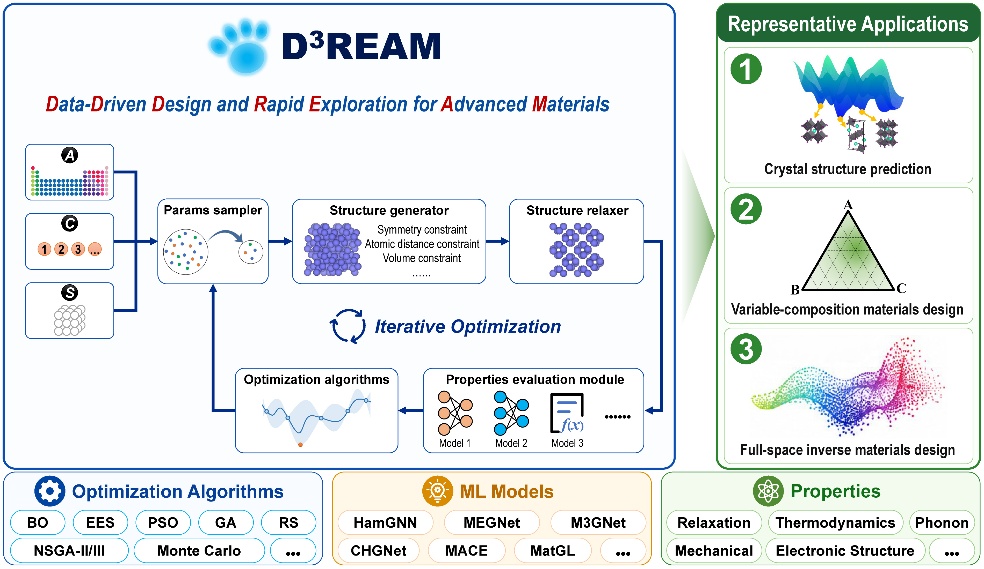
D3REAM 材料逆向设计框架:从元素、配比和结构到结构生成、性质评估与迭代优化

从目标性质出发,探索材料的全空间逆向设计

材料的性质由元素类型(A)、化学配比(C)和结构构型(S)共同决定,三者的组合构成庞大的设计空间,给具有目标性质的新材料发现带来挑战。我们团队聚焦材料逆向设计,从目标性质出发寻找合适的化学组成与原子排列,不局限于已知化合物或预设结构原型。

我们发展了联合探索(A、C、S)全空间的逆向设计方法:利用全局优化算法引导目标性质导向的搜索,通过机器学习原子间势与性质预测模型快速评估候选材料,并通过主动学习协同推进材料探索与模型迭代优化。

相关方法已应用于晶体结构预测、新型超硬 B–C–N 化合物发现、全空间功能材料设计,以及通用机器学习势的数据采样与模型训练。通过结合先进的机器学习与优化算法,我们致力于寻找兼顾多性质要求的新材料,发展可靠、可迁移的逆向设计方法。

物理发现

围绕材料宏观性质背后的物理机制,从超硬材料和负热膨胀材料出发,寻找可解释、可迁移的结构-性质规律。

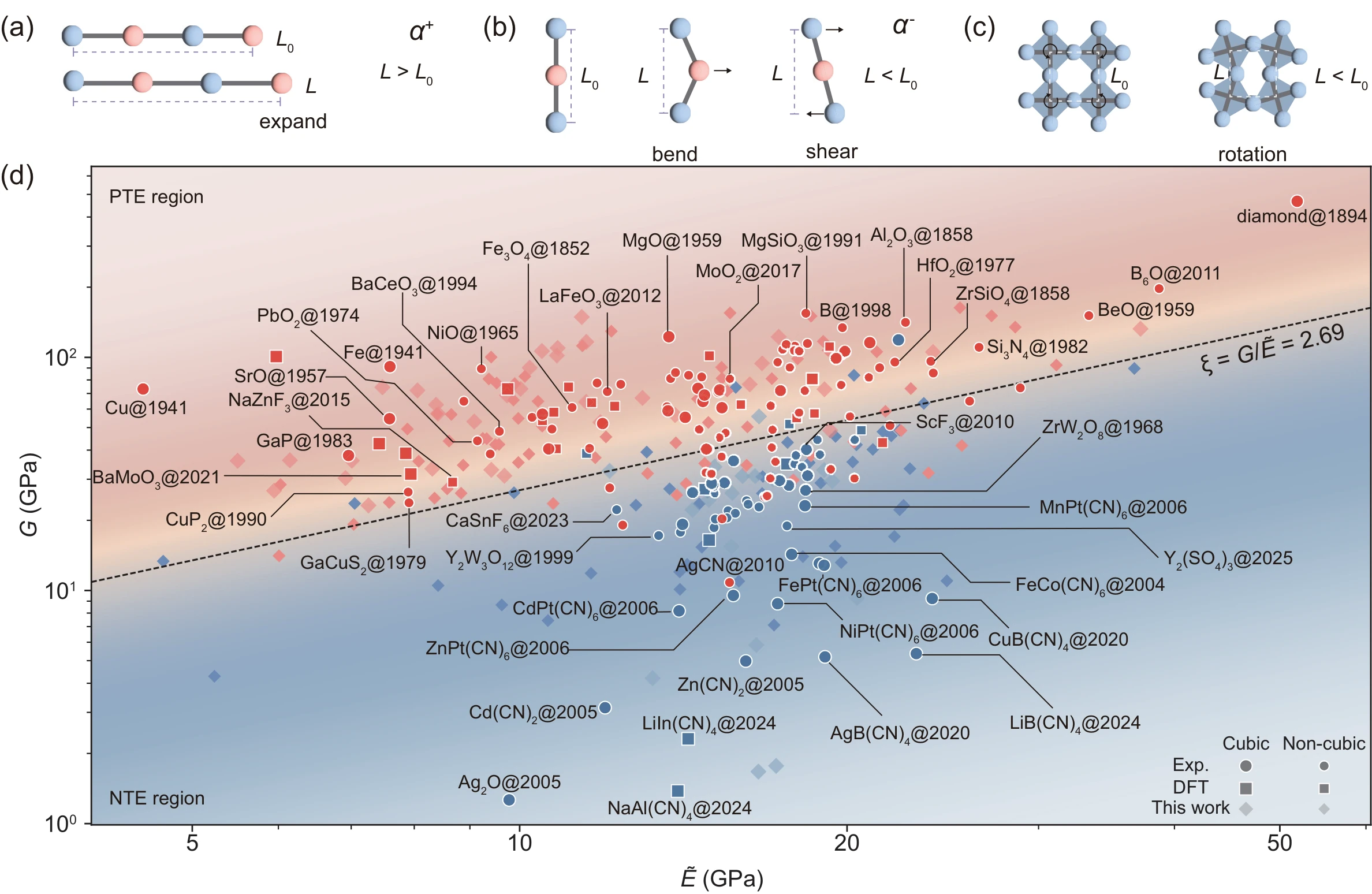
由剪切模量与成键模量构成的正负热膨胀材料图景

用剪切-成键描述符绘制负热膨胀材料的可解释图景

负热膨胀材料对于降低器件中的热应力非常重要,但这类材料长期缺少能够跨化学空间迁移的设计原则。研究将百余年的热膨胀数据与机器学习结合,找到由剪切模量和成键模量构成的可解释描述符。

这个描述符把正、负热膨胀材料放入同一张力学图景,并指导通用机器学习势驱动的高通量有限温度模拟。由此预测了 3,665 种具有宽工作温区的负热膨胀晶体,随后合成和表征了 11 种此前未报道的化合物,验证了框架的可迁移性。

The Shear-Bond Descriptor and Universal Machine-Learning Potential Enable Large-Scale Discovery of Negative Thermal Expansion Materials

Guangming Chen, Shun Tian, Kaiwei Feng, Yilun Liu, Wanjian Yin, Qilong Gao & Ke Zhou · Journal of the American Chemical Society · 2026

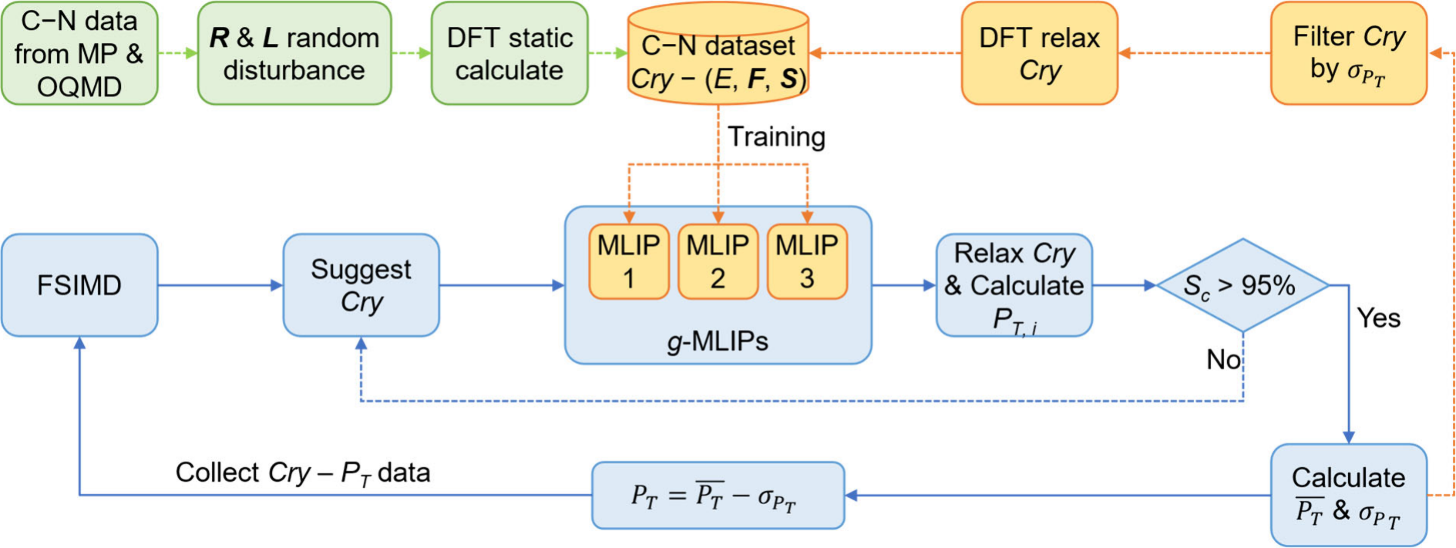
VC-IMD 变量组成逆向设计流程图

用全局机器学习势和多目标优化,反向设计超硬 C–N 化合物

钻石的硬度为新型超硬材料设定了很高的参照,但传统晶体结构预测往往需要预先指定组成或结构。这里建立可变组成逆向设计流程,让机器学习势在搜索过程中持续更新,并同时处理离散的化学计量与连续的晶体结构。

经过多轮搜索,研究发现了 38 种此前不在主要材料数据库中的稳定 C–N 超硬材料,其中 C3(P6322)预测硬度达到 97.4 GPa,超过文中采用的金刚石参照值。

De Novo Inverse Design Superhard C−N Compounds via Global Machine Learning Interatomic Potentials and Multiobjective Optimization Algorithm

Guanjian Cheng & Wan-Jian Yin · J. Phys. Chem. Lett. · 2025

Materials Synthesizability and Synthesis Planning

Connect predicted crystals with experimental realization by combining physical descriptors, historical synthesis knowledge, and language-model reasoning.

Figure 1 of the PIRAG-LM manuscript: structured synthesis knowledge-base construction, physics-informed retrieval, and interpretable synthesis planning

Interpretable inorganic crystal synthesis planning with physics-informed retrieval

Thermodynamic stability alone does not establish whether a material can be synthesized or specify how to make it. PIRAG-LM treats synthesizability as a route-dependent assessment, evaluating candidate pathways through thermodynamic feasibility, kinetics, and accessibility.

A structured synthesis knowledge base covers 13,820 experimentally synthesized inorganic crystals and links each material to literature-derived routes, precursors, processing conditions, and evidence. Chemical, structural, and thermodynamic similarity retrieve relevant precedents; the language model uses these records to propose synthesis plans and explain their evidence and anticipated challenges.

In the manuscript's evaluation, synthesis-method prediction reaches 91.4% accuracy, compared with 72.1% for the language model alone. Experimental synthesis of five new compounds through solid-state and solution routes demonstrates how the framework can help translate crystal predictions into experimentally realized materials.

Interpretable inorganic crystal synthesis planning with physics-informed retrieval-augmented language models

Wei-Jian Jiang, Ye-Nan Sha, Hui Guo, Jie Chen, Yu-Cai Liang, Ke Zhou, Qi-Long Gao, Dong-Lin Han, Xin-Gao Gong, Wan-Jian Yin · Manuscript